Tongue Diagnosis in Traditional Chinese Medicine: What Your Tongue Reveals About Your Health
In Traditional Chinese Medicine (TCM), the tongue is considered a powerful diagnostic tool. For thousands of years, practitioners have observed the color, shape, and coating of the tongue to understand what is happening inside the body.
Unlike many modern diagnostic methods, tongue diagnosis is completely non-invasive. By carefully examining the tongue, a trained practitioner can gather important clues about the condition of the organs, the circulation of Qi, and the balance of Yin and Yang in the body.
This method is known as tongue diagnosis and remains one of the most important diagnostic techniques used in Traditional Chinese Medicine today.
Why the Tongue Reflects Internal Health
According to TCM theory, the tongue is connected to the internal organs through the body’s meridian system. Because of this connection, changes inside the body may appear on the surface of the tongue.
The tongue provides information about several aspects of health, including:
- the strength of Qi and Blood
- the condition of internal organs
- the presence of heat or cold in the body
- the accumulation of dampness or phlegm
For this reason, observing the tongue is often one of the first things a practitioner does during a consultation.
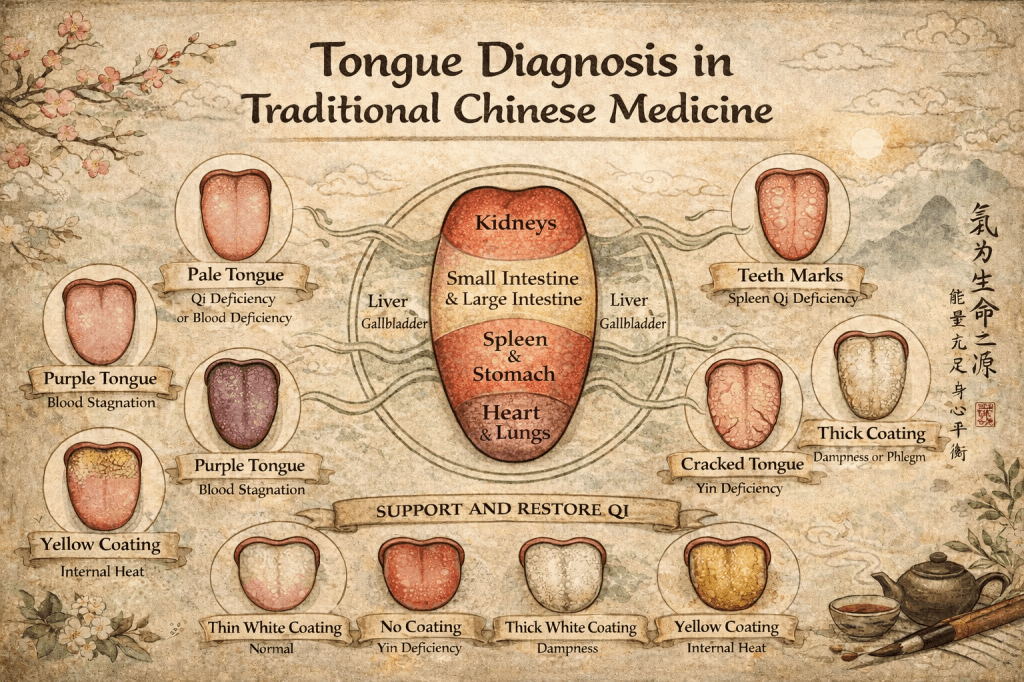
The Different Areas of the Tongue
In TCM, different parts of the tongue correspond to different organ systems. By observing specific areas, practitioners can gain insight into which organs may be out of balance.
- Tip of the tongue – Heart and Lung
- Center of the tongue – Spleen and Stomach
- Sides of the tongue – Liver and Gallbladder
- Back of the tongue – Kidneys and Bladder
Changes in color, swelling, coating, or texture in these areas may indicate patterns of imbalance within the corresponding organ systems.
What Tongue Color Can Indicate
The color of the tongue body can reveal important information about the body’s internal state.
Pale tongue
This may indicate Qi deficiency or blood deficiency. People with pale tongues often experience fatigue, weakness, or low energy.
Red tongue
A red tongue may suggest excess heat in the body. This can appear in conditions related to stress, inflammation, or emotional tension.
Purple or bluish tongue
This may indicate blood stagnation or poor circulation.
The Importance of Tongue Coating
The coating on the surface of the tongue also provides important diagnostic clues.
Thin white coating
This is generally considered normal and indicates healthy digestion.
Thick coating
A thick coating may suggest the presence of dampness or phlegm in the body.
Yellow coating
This may indicate internal heat.
No coating
This can suggest Yin deficiency or depletion of body fluids.
Common Tongue Shapes and What They Mean
Besides color and coating, the shape of the tongue is also important.
- Swollen tongue – often related to dampness or spleen Qi deficiency
- Thin tongue – may indicate blood deficiency
- Cracked tongue – can suggest Yin deficiency
- Teeth marks on the sides – commonly associated with spleen Qi deficiency
Tongue Diagnosis and Daily Self-Observation
Although tongue diagnosis is traditionally performed by trained practitioners, observing your own tongue can sometimes reveal useful insights about your health.
A good time to observe the tongue is in the morning before eating or brushing your teeth. Natural lighting is also important for seeing the true color of the tongue.
However, it is important to remember that many factors can temporarily influence the appearance of the tongue, including food, drinks, medications, and hydration levels.
The Role of Tongue Diagnosis in Modern TCM
Today, tongue diagnosis continues to play a central role in Traditional Chinese Medicine. Practitioners combine tongue observation with other diagnostic methods such as pulse diagnosis, patient history, and physical examination.
Together, these techniques help create a comprehensive picture of the body’s internal balance.
Rather than focusing only on symptoms, TCM aims to understand the deeper patterns that influence health. Tongue diagnosis is one of the tools that allows practitioners to see those patterns more clearly.
By learning to observe the body carefully, Traditional Chinese Medicine reminds us that many signs of health and imbalance are visible if we know where to look.
 TCM QiDao
Leave a comment