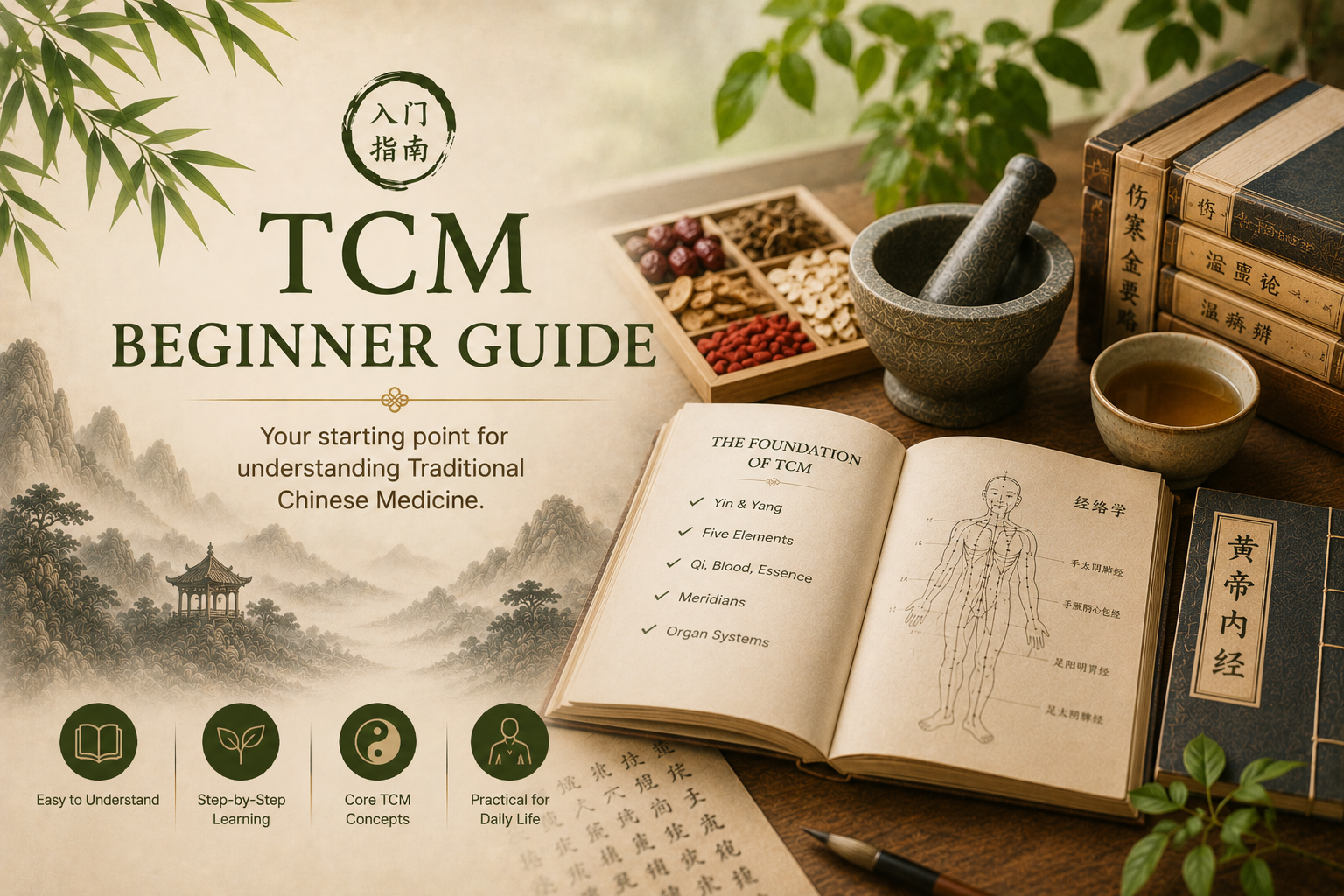
Traditional Chinese Medicine Beginner Guide
Traditional Chinese Medicine, often called TCM, is a holistic system of health that looks at the body, mind,
emotions, lifestyle, food, and environment as one connected whole. Instead of focusing only on isolated symptoms,
TCM tries to understand the deeper patterns behind imbalance.
This beginner guide introduces the core ideas of Traditional Chinese Medicine: Qi, Yin and Yang, the Five Elements,
meridians, organ systems, diagnosis, diet therapy, herbal medicine, acupuncture, and acupressure.
If you are completely new to this portal, you may also want to visit the
Start Here page first.
What Is Traditional Chinese Medicine?
Traditional Chinese Medicine is a traditional medical and philosophical system developed in China over many centuries.
It is based on the idea that health depends on balance, movement, nourishment, and harmony within the body.
In TCM theory, symptoms are not seen only as separate problems. They are often understood as signs of broader patterns,
such as Qi deficiency, Yin deficiency, Yang deficiency, Dampness, Heat, Blood deficiency, or Liver Qi stagnation.
TCM includes several major branches, such as acupuncture, herbal medicine, diet therapy, movement practices,
breathing, bodywork, and lifestyle guidance.
Qi: The Idea of Vital Energy
Qi is one of the most important concepts in Traditional Chinese Medicine. It is often translated as vital energy,
life force, or functional energy. In TCM, Qi supports movement, warmth, digestion, immunity, breathing,
circulation, and daily vitality.
When Qi is strong and flowing smoothly, the body is traditionally understood to function with better resilience.
When Qi becomes weak, blocked, or unbalanced, symptoms may appear.
For example, tiredness, weak digestion, shortness of breath, or low motivation may be discussed in TCM through the
idea of Qi deficiency.
Related guide:
Why Am I Always Tired? Qi Deficiency in Traditional Chinese Medicine
Yin and Yang
Yin and Yang describe two complementary forces that exist in nature and within the body. Yin is associated with
cooling, nourishing, resting, moistening, and inward qualities. Yang is associated with warming, activating,
moving, transforming, and outward qualities.
Health in TCM is not about having only Yin or only Yang. It is about the dynamic balance between them.
Too much heat, too much cold, too much dryness, too much stagnation, or too much weakness may all be interpreted
through Yin-Yang relationships.
For example, a person who feels cold all the time may be discussed through Yang deficiency, while heat sensations,
dryness, or restlessness may sometimes be discussed through Yin deficiency or Heat patterns.
Related guide:
Why Do I Feel Cold All the Time? Yang Deficiency in TCM
The Five Elements
The Five Elements are Wood, Fire, Earth, Metal, and Water. In TCM, they are used as a symbolic framework for
understanding relationships between organs, emotions, seasons, colors, tastes, and natural cycles.
- Wood is connected with the Liver and Gallbladder, spring, movement, growth, and anger.
- Fire is connected with the Heart and Small Intestine, summer, joy, warmth, and the Shen.
- Earth is connected with the Spleen and Stomach, digestion, nourishment, and stability.
- Metal is connected with the Lungs and Large Intestine, breathing, skin, grief, and letting go.
- Water is connected with the Kidneys and Bladder, deep vitality, fear, reproduction, and aging.
The Five Elements are especially useful for understanding the TCM organ systems and their emotional and seasonal
associations.
Meridians and Energy Pathways
Meridians are the pathways through which Qi is traditionally understood to move. Acupuncture and acupressure points
are located along these meridian pathways.
In TCM theory, meridians connect different areas of the body and help explain why a point on the hand, foot, arm,
or leg may be used in relation to symptoms elsewhere.
Related guide:
Understanding Meridians in Traditional Chinese Medicine
TCM Organ Systems
In Traditional Chinese Medicine, the organ systems are not limited to the physical organs known in modern anatomy.
They describe broader functional networks involving energy, emotions, fluids, digestion, breathing, sleep,
reproduction, and adaptation to the environment.
For example, the Liver system is connected with the smooth flow of Qi and emotional tension. The Spleen and Stomach
are connected with digestion and energy production. The Kidneys are connected with deep vitality, Essence,
reproduction, and aging.
Explore the full hub:
TCM Organ Systems
Diagnosis in Traditional Chinese Medicine
TCM diagnosis focuses on recognizing patterns of imbalance. A practitioner may look at symptoms, constitution,
lifestyle, emotions, sleep, digestion, temperature, energy, tongue appearance, and pulse quality.
Tongue diagnosis and pulse diagnosis are two well-known traditional methods. They are not used as isolated tools,
but as part of a broader pattern-based assessment.
Related guides:
Common TCM Patterns
A TCM pattern is a way of describing how imbalance appears across the body. The same symptom may have different
pattern explanations depending on the person.
Common beginner patterns include:
- Qi deficiency — often discussed with fatigue, weak digestion, low energy, or shortness of breath.
- Yang deficiency — often discussed with coldness, low warmth, and weakness.
- Yin deficiency — often discussed with dryness, heat sensations, restlessness, or night sweating.
- Dampness — often discussed with heaviness, bloating, sluggishness, or fogginess.
- Liver Qi stagnation — often discussed with stress, tension, irritability, PMS, or emotional constraint.
Related guide:
Liver Qi Stagnation in Traditional Chinese Medicine
Diet Therapy in TCM
TCM diet therapy looks at food through qualities such as warming, cooling, drying, moistening, moving, nourishing,
and strengthening. Food is not only viewed through calories or nutrients, but also through its traditional energetic
properties.
For example, some foods are traditionally used to support Qi, some to strengthen the Spleen, some to clear Heat,
and some to reduce Dampness.
Explore the hub:
Diet Therapy
Herbal Medicine in TCM
Chinese herbal medicine is a major branch of TCM. Herbs are traditionally selected according to patterns,
constitution, temperature, taste, organ affinity, and formula strategy.
Herbal medicine should be approached carefully. Herbs may interact with medications, may not be appropriate for
certain conditions, and should be used with professional guidance when treating health concerns.
Explore the hub:
Herbal Medicine
Acupuncture and Acupressure
Acupuncture uses fine needles at specific points, while acupressure uses finger pressure or gentle stimulation.
Both are based on the idea of meridians and acupuncture points.
Acupressure is often used as a gentle self-care practice for relaxation, stress, tension, digestion, sleep,
and general wellbeing. It should be used carefully and should not replace medical care.
Related guides:
How to Start Learning TCM
If you are new to Traditional Chinese Medicine, the best approach is to learn in layers.
- Start with Qi, Yin and Yang, Five Elements, and meridians.
- Learn the TCM organ systems and how they relate to emotions, seasons, and symptoms.
- Explore basic diagnosis concepts such as tongue diagnosis and pattern recognition.
- Study common patterns such as Qi deficiency, Yang deficiency, Dampness, and Liver Qi stagnation.
- Move into practical areas such as diet therapy, acupressure, and lifestyle guidance.
You can return to the Start Here page anytime to navigate the portal.
Frequently Asked Questions
Is Traditional Chinese Medicine the same as acupuncture?
No. Acupuncture is one branch of Traditional Chinese Medicine. TCM also includes herbal medicine, diet therapy,
diagnosis, movement practices, breathing, bodywork, and lifestyle guidance.
What is Qi in simple terms?
Qi is often described as vital energy or functional energy. In TCM, it supports movement, warmth, digestion,
breathing, immunity, and general vitality.
What is the difference between Yin and Yang?
Yin is associated with cooling, nourishing, resting, and inward qualities. Yang is associated with warming,
activating, moving, and outward qualities. Health is understood as a dynamic balance between them.
Is TCM safe?
Many TCM-based lifestyle ideas, such as gentle diet awareness or basic acupressure, may be used as educational
self-care. However, herbs, acupuncture, chronic symptoms, pregnancy, serious illness, and medication interactions
require professional guidance.
Where should beginners start?
Beginners should start with the foundations: Qi, Yin and Yang, Five Elements, meridians, organ systems,
and basic diagnosis. The Start Here page is a good navigation point.
Continue Learning
Continue with these related hubs and beginner-friendly guides:
Educational Note
This guide is for educational purposes only. It is not medical advice, diagnosis, or treatment. Traditional Chinese
Medicine can offer a holistic framework for understanding health, but it should not replace professional medical care.
If you have serious, persistent, worsening, or unexplained symptoms, consult a qualified healthcare professional.
Do not stop or change prescribed medication or treatment without medical guidance.

